

SINGLE PARENT: ‘SOLE RESPONSIBILITY’ FOR A MINOR CHILD?


In family visa applications the UK immigration rules require evidence that there will be adequate accommodation for family members, without access to public funds. This will include other family members (or other persons) who are not included in the application but who live in the same household.
The applicant/s do not need to own or even necessarily have to rent the whole of the property or any part thereof but must show which part of the home they occupy exclusively and what arrangements have been made e.g., sharing with family members or friends.
The purpose of the applicable legislation is to ensure that the ‘family home’ isn’t overcrowded and that public health regulations aren’t contravened.
The Housing Act 1985 sets two tests referring to ‘the room standard’ and ‘the space standard’.
The ‘room standard’ will not be met if two people (who are not the Applicant and his/her partner) aged 10 or over of the opposite sex have to sleep in the same room. The accommodation will then be regarded as overcrowded.
The ‘space standard’ determines whether or not the number of people sleeping in the property exceeds that permitted by the Act. The Act provides a table which will not be discussed in detail in these notes.
A ‘room’ in the context of the Act means it is available as sleeping accommodation if it is of a type normally used in the locality either as a bedroom or as a living room. It cannot be smaller than 50 square feet to be taken into account as a ‘room’.
For assistance and advice contact DEPNER IMMIGRATION CONSULTANTS info@depner-immigration.com
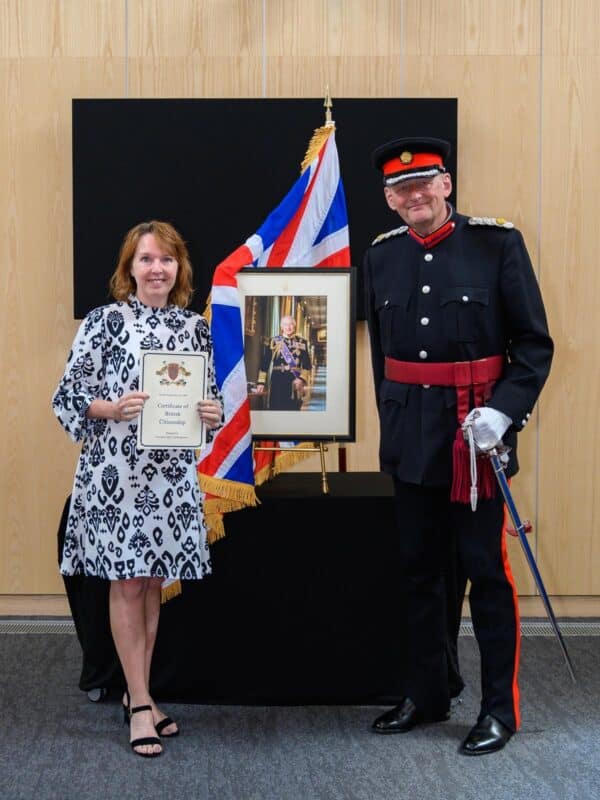
You have come so far on your UK immigration journey; one visa after another, indefinite leave to remain and now, time to apply for naturalisation?
You should appreciate that so-called ‘naturalisation’ IS NOT AN ENTITLEMENT, in other words you do not have a right to naturalise. The Secretary of State may, IF HE THINKS FIT, grant you a certificate to naturalise as a British citizen. The words “if he thinks fit” indicates a discretion to grant or not to grant.
Notably, many applications are refused (reportedly up to 30% of applications); often because applicants have applied even though they cannot satisfy the residence requirement to be present in the UK at the beginning of the residential qualifying period.
The requirements for naturalisation are set out in Section 6 with reference to Schedule 1 of the British Nationality Act 1981.
It is of the utmost importance to have regard to the guidelines under which caseworkers exercise (on behalf of the Secretary of State) the said discretion and under what circumstances they might (or definitely won’t) cut you some slack!
For advice and assistance please write to info@depner-immigration.com
or call 0333 200 5158


Why is the UK ancestry route so advantageous (to eligible Commonwealth citizens)?
Some of the salient advantageous aspects are:
• It is a route to settlement (Indefinite Leave to Remain).
• The application fees are relatively low by comparison (currently £516).
The starting point is of course to determine whether an applicant has a “qualifying grandparent”; a PATERNAL OR MATERNAL grandparent born in the UK, the Channel Islands or the Isle of Man.
If Suitability and Eligibility requirements are not met the application WILL be refused.
Daniel Dippenaar, Barrister-Immigration Consultant
Three generations; SCOTTY, born in the UK; his son JACK born in a Commonwealth country and OLIVER, Jack’s son, born in the same Commonwealth country.
Jack holds a South African passport, so does Oliver.
Oliver’s UK born granddad potentially opens up the UK ancestry route to him and his immediate family members (spouse / partner / children) to work and live in the UK. Of course, we will assume that Oliver is over the age of 17.
BUT WHAT ABOUT JACK AND HIS WIFE (Oliver’s mother)? Jack is married to a non-EU citizen – lovely SARAH.
Returning to the three generations; what we have here is a British citizen (granddad Scotty), British citizen by descent (father Jack) and Oliver (grandson claiming ancestry).
Jack, if he doesn’t have one yet, will have to apply for his FIRST British passport. As a confirmed British citizen, he may very well be able to bring Sarah to the UK as his dependant. However, he will have to apply under the ‘super-strict’ requirements of Appendix FM of the UK immigration rules applicable to British citizens bringing such a spouse/partner to the UK.
Oliver on the other hand, assuming he has immediate family dependants of his own, would fall under an entirely different set of rules which are less strict and open for discretionary application by UK Home Office caseworkers.
For all your FIRST UK passport applications, ancestral and family visas, enquiries and assistance, please contact DEPNER IMMIGRATION CONSULTANTS at 0333 200 5158
For more information and assistance contact info@depner-immigration.com
Daniel Dippenaar – Barrister-Immigration Consultant 6 March 2020

Your first point of call in relation to British citizenship will usually require a thorough understanding of the British Nationality Act 1981.
It provides a number of sections, each with different requirements for children to be registered as a British citizen.
Sections 1(3), 1(3A) and 1(4): registration by entitlement for those born in the UK after 1 January 1983.
Section 1(4): entitlement provision for either a child or an adult.
Sections 3(2) and 3(5): entitlement of minors born outside the UK and qualifying territories to British citizens by descent.
And finally, section 3(1): discretionary provision for registration as a minor.
Today, these notes will deal with only one of the above; section 1(3):
A child is entitled to registration under section 1(3) if he/she was born in the UK, but didn’t become a British citizen at birth, because at the time neither parent was a British citizen or settled in the UK. If either of the parents of such a child (after his/her birth) becomes a British citizen or settled in the UK and the child is still a minor at that time and can show that he/she is of good character (if over the age of 10) British citizenship otherwise than by descent is likely to be granted by registration.
It should be noted that the application must be received when the child is still under the age of 18.
For more information and assistance contact info@depner-immigration.com
Daniel Dippenaar – Barrister-Immigration Consultant 28 February 2020